How to Build Trust at work

The following are ways to create and preserve trusting relationships in a trust promoting work environment:

  • Hire and promote people, who are capable of forming positive, trusting interpersonal relationshipswith people who report to them, to supervisory positions. The supervisor's relationship with reporting employees is the fundamental building block of trust.

 How to Build Trust at work
  • Develop the skills of all employees and especially those of current supervisors and people desiringpromotion, in interpersonal relationship building and effective interpersonal skills.
  • Keep staff members truthfully informed.Provide as much information as you can comfortably divulge as soon as possible in any situation.
  • Expect supervisors to act withintegrityand keep commitments.If you cannot keep a commitment, explain what is happening in the situation without delay. Current behavior and actions are perceived by employees as the basis for predicting future behavior. Supervisors who act as if they are worthy of trust will more likely be followed with fewer complaints.

 How to Build Trust at work
  • Confront hard issues in a timely fashion.If an employee has excessiveabsences or spends work time wandering around, it is important to confront the employee about these issues. Other employees will watch and trust you more.
  • Protect the interest of all employees in a work group.Do not talk about absent employees, nor allow others to place blame, call names, or point fingers. Employees learn to trust when they know that their names are not being taken in vain.
  • Display competence in supervisory and other work tasks.Know what you are talking about, and if you don’t know — admit it. Nothing builds trust more effectively than a manager saying that he doesn't know and will find out so that everyone is informed. The worst reaction occurs when a manager pretends to know and offers faulty information. Employees forgive a lack of knowledge - they never forgive a liar.
  • Listen with respect and full attention.Exhibit empathy and sensitivity to the needs of staff members. Trust grows out ofthe belief that you understand and can relate.
  • Take thoughtful risks to improve service and products for the customer.When you demonstrate that risk-taking is promoted, you demonstrate that employees may do the same - especially if there are no consequences when a thoughtfully considered risk goes awry. When consequences for risk-taking don't occur, trust is cemented.
  • If you are a supervisor or a team member,set high expectations and act as if you believe staff members are capableof living up to them. This trust and support will draw forthyour employees'best efforts and their trust in return.

 How to Build Trust at work

The Human Resources professional has a special role in promoting trust. So do line managers. You coach managers and supervisors about all of the appropriate roles described above in building trust relationships. You also influence the power differentials within the organization by developing and publishing supportive, protective, honorable policies. You are influential in building appropriate social norms among people who are doing different jobs in your organization.

 How to Build Trust at work

Engage in trust building andteam building activitiesonly when there is a sincere desire in your organization to create a trusting, empowering, team-oriented work environment. Engaging in these activities for any but honorable reasons is a travesty and a sham. People will know the difference, or they will find out, and then, they will never trust you.



 

Job Classification

Job classification is a system for objectively and accurately defining and evaluating the duties, responsibilities, tasks, and authority level of a job. The job classification, done correctly, is a thorough description of the job responsibilities of a position without regard to the knowledge, skills, experience, and education of the individuals currently performing the job.

Job Classification
Job classification is most frequently, formally performed in large companies, civil service and governmentemployment, nonprofit agencies, and colleges and universities. The approach used in these organizations is formal and structured withpay or salary gradesattached to the results of the job classification. In summary, the results of a job classification create parity in job titles, consistent job levels within the organization hierarchy, and salary ranges that are determined by identified factors. These factors include market pay rates for people doing similar work in similar industries in the same region of the country, pay ranges of comparable jobs within the organization, andthe level of knowledge, skill, experienceand educationneeded to perform each job.

Job Classification
Informal forms of job classification are used even in smaller and mid-sized companies and agencies to generate a sense of fairness across equivalent employee jobs. This form of job classification can be as simple as grouping similar positions in a broadband.

Job Classification
The Hay System of Job Classification

One popular, commercial job classification system is the Hay Classification system. The Hay job classification system assigns points to evaluate job components to determine the relative value of a particular job to other jobs. The Hay method measures three components in all jobs: the knowledge required, the problem solving required, and the level of accountability.

Job Classification
The Hay method compares the relative value of comparable jobs to maintain parity across an organization. For purposes of larger organizations with many departments and locations, union represented jobs, and organizations with hierarchical, rigid pay or salary grades, and needed internal equity, a system such as Hay, is appropriate. Working with Hay job classification, an evaluator uses a job evaluation instrument or questionnaire that is filled out by thedepartment requesting the job or evaluation.

Job Classification
Trained to appropriately assign points, the evaluator assigns points to determine where to place a job in the job classification system. The placement of the job determines the pay or salary grade within the organization'scompensation system.


منبع: Padidehtabar company

Ice Breaker Questions at Meetings

Needice breakers for your meetings at work? These are sampleice breakersthat you can use to start out your meetings, retreats,team building sessions, or training classes. With the right ice breaker question, you can focus the group on the content of the meeting. Or, you can decide that you want the participant warm-up focused on laughter and fun. Ice breakers help yourmeeting participants get to know each other and they warm up the conversation between participants at the meeting.

 Ice Breaker Questions at Meetings

Once you use ice breakers to break the ice, the participant discussionsflow comfortably. They are an excellent opportunity to encourage more questions, exchanges, and sharing of experiences among participants. They encourage conversation which is typically slow when a group gets together for the first time. People are a little bit uneasy. They don't want to draw negative attention to themselves. And, they really, really, really don't want to sound or look stupid or uninformed.

 Ice Breaker Questions at Meetings

For your regular meetings, where participants know each other, ice breaker questions can still serve a purpose. You can use them to get the conversation started and, especially when they focus on the topic of the meeting, they are a good way tomove participants into the main meeting agenda. Here are guidelines abouthow to facilitate and use theseice breaker questionsfor meetings. Take a look at these guidelines before you use any of the following suggested questions to open your meeting or training class. You’ll find helpful tips that will make your facilitation and the meeting successful.

 Ice Breaker Questions at Meetings

Note that some of these questions are more suitable for participants who don't work together and are meeting for the first time. Others are more suitable for people who work together regularly. Some of the questions will work in either situation. Note also, that the choice of an ice breaker question that you choose to use in your meeting is limited only by your imagination. These samples are offered to get you started.

 Ice Breaker Questions at Meetings

Sample: Ice Breaker Questions:


 What's rocking your work world today?

 What do employees complain about in your organization?

 What are you most worried about at work this month?

 What characteristic do you value the most in your coworkers?

? What is the most important personal attribute that you bring to your job

What are you most excited about in relation to your job this year?

What's one work-related skill that you'd like to develop, especially if you could do it easily? 


5 Game Techniques Related To Facts


5 Game Techniques Related To Facts

1. Stories

Researchers have found that the human brain has a natural affinity for narrative construction. People tend to remember facts more accurately if they encounter them in a story rather than in a list, studies find; and they rate legal arguments as more convincing when built into narrative tales rather than on legal precedent. This picks up on the elaboration technique embedding facts into a known context of the learner and is a key element in games. The story element of a game can help to encode the content more richly in the learner’s brain and help them with recall of the facts when needed. So a game that has a story helps lead to learning. In fact, when you listen to a story,your brain "rehearses" the elements of the story.

5 Game Techniques Related To Facts

2. Sorting

These are games where a learner needs to place content into the right slot or location. At the factual level, the learner doesn’t need to be able to understand the different categories or sorting requirements; they just need to identify what goes where. In fact, these kinds of games are good for having multiple levels, once the learner sorts correctly at the factual level, the next step is to have them sort by conceptual relationships instead of identification (moving up the knowledge hierarchy).

5 Game Techniques Related To Facts

3. Matching

These games require the learner to link an image or idea to another image or idea. Any game that requires matching fits into this category. These types of games can also be used to teach concepts using the same leveling up approach as described above. As an example, young adults who are learning to drive often do not appropriately identify road hazards and therefore don’t exercise the right amount of caution. To help overcome that obstacle, a game was created to teach them to identify various road signs and obstacles. In this game,the learners are asked to match the appropriate items with a work zone. The learner identifies the right items and drags the items onto the work zone allowing them to link the visual of the item with the idea of a work zone.


5 Game Techniques Related To Facts


4. Replay ability

When dealing with teaching facts, it’s a good idea to make the game replay able so that the player repeats it again and again. This doesn’t meant the content needs to be exactly the same but having similar content presented over and over again helps with memorization. While almost any game can be played again, the trick with declarative knowledge games is to keep the content fresh but still related to the knowledge that needs to be memorized. When considering the creation of games to teach facts, consider how you can get the learners to play it again and again.

5 Game Techniques Related To Facts

5. Trivia

Trivia is nothing but facts and declarative knowledge. Trivia games provide repetition, association and organizing, trivia games work very well for basic knowledge. A well-known example of a trivia game is Jeopardy or even Trivial Pursuit. One example is using a trivia game to reinforce product knowledge among salespeople. A trivia game was developed to help salespeople to memorize the features of new product so they could intelligently discuss them with customers. The game was played on a daily basis and each morning the salesperson would receive an email with a link to the game. The game presented them with five questions that they answered. The questions were all related to the product they would be launching in a few weeks. The goal was to take advantage of distributed practice, as discussed in chapter, and provide repetition for the learners. The questions were drawn from a pool of questions so the likelihood of an exact repeat of a question was small but it could occur. The scores were tailed each week on leader board that could also be viewed from the email. At the end of a five week period, the salespeople with the highest scores received a prize.

5 Game Techniques Related To Facts

Conclusion

As you can see, teaching basic knowledge with the need for reviewing content over and over and creating associations can be taught effectively if the serious learning game is appropriately designed.

صنعت بیمه در ایران-سه ماهه چهارم 2016

BMI Industry View
BMI View: Sanctions relief is set to boost the Iranian insurance market as rising household incomes leads to growth in life, motoring and health lines, which dominate the market. Smaller lines will also grow, but from a very low base. Sustained growth and market development will require foreign capital and expertise.
An end to sanctions - apart from US sanctions, which will continue to cause hurdles for businesses with exposure to US markets - will provide opportunities for tie-ups between local and foreign partners.
However, the state will continue to remain a significant player in the market and this could restrict opportunities for competition among privately owned insurers.


 صنعت بیمه در ایران-سه ماهه چهارم 2016


 صنعت بیمه در ایران-سه ماهه چهارم 2016

Key Updates And Forecasts
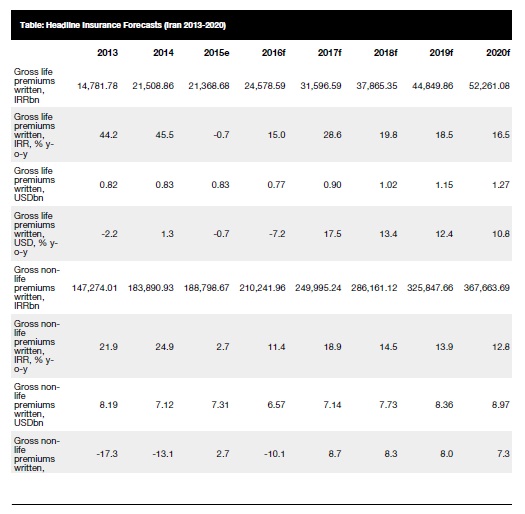
■ Iran's life gross written premiums are set to grow 53% from 2015 in US dollar terms to USD1.27bn in 2020, while the non-life sector will grow just 23% over the same period to USD8.97bn.
■ Overall claims are likely to rise as a result of a recent Islamic ruling which put women on a parity with men; in the past, women were only allowed half the level of men in the event of injury, disability or death. This will lead to increased accident and motoring insurance claims.
■ Rising car purchases will lead overall growth in the Iranian insurance sector with mandatory motoring insurance. The high level of car accidents will also support higher premiums, although improvements in car safety due to foreign investment in the automotive sector could mitigate the situation.
■ Foreign investors are cautious about tie-ups with local partners due to the dominance of state insurance - particularly Bimeh Iran's 50%+ market share - and the continuation of US sanctions. Washington's unilateral sanctions are a source of confusion among investors who are exposed to US markets and are concerned about potential prosecution.


Important strategies for Career Development

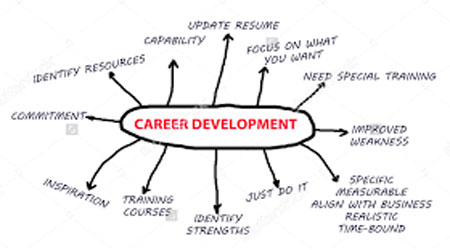
Here are additional thoughts about career management and Dr. Tracey Wilen-Daugenti, Vice President and Managing Director of Apollo Research Institute and Visiting Scholar in Stanford University's Media X program, recommends fivecareer management strategies:

 Important strategies for Career Development

1. Could your career development and management use help to gain momentum? People who are the most successful and satisfied in their careers have proactively determined what they want from work. Once they’ve decided on their goals, they make a plan to accomplish the goals.

 Important strategies for Career Development

2. Developing a timeline with career goals and expected milestones is also an effective way to manage your career. Bringing your boss and his or her sponsorship andmentoring into the picture will ensure that you have an internal mentor who will help you manage your career.

 Important strategies for Career Development

3. Some companies have formal programs to help employees develop their careers. In others, you will need to informally pursue your career development. Companies with programs generally focus energy on helping employees develop and follow acareer path.

4. Thecareer pathis discussed at several meetings bi-annually with the employee’s boss. The company doesn’t own the career path; the employee does. But, the company demonstrates commitment to its employees by assisting where possible with resources of time and dollars.

 Important strategies for Career Development

5. Career paths are recommended for the same reason that I recommend goals. They are the written plan that can help each employee focus on what is most important to his or her fulfillment and success. Without a plan, you can feel rudderless and you have no benchmark against which you can measure your progress.

 منبع: Padidehtabar company

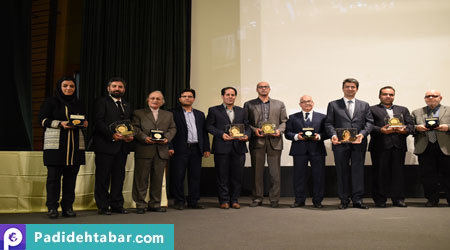
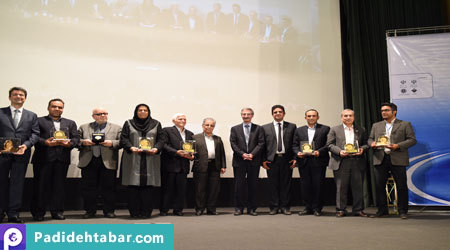
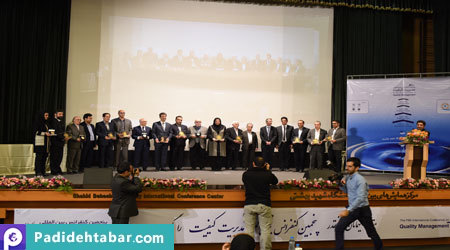
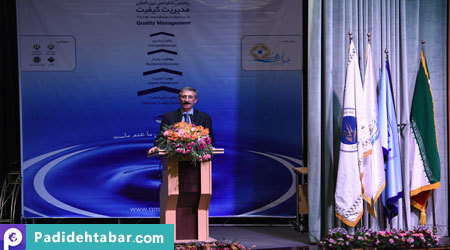
Donation of the special emblem in International Quality Conference to Padidehtabar company

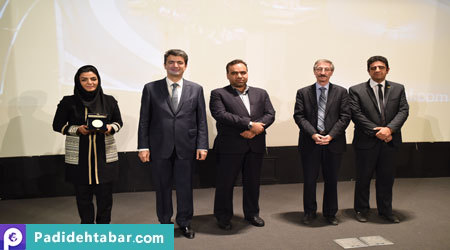
Doctor Zainab Habibi Tabar, founder and chairman of the board on behalf of Padidehtabar received a special emblem at the Fifth International Conference of Iran Quality Management.

Reportedly of Padidehtabar Public Relations , On the day of the closing Conference Iran Quality Management was appreciated from the brand and authorities of organizations and agencies that are active in the field of quality by donating emblem.

In this regard, Doctor Zainab Habibi Tabar founder and chairman of Padidehtabar company in the promotion of new training methods and holding Semitheater of Quality and Consumer Right and Semitheater of Quality and Service was celebrated by donating special emblem at International Quality Conference.


Effective steps in job description

Use these steps to develop your job descriptions.

 Gather the appropriate people for the task

The manager to whom the position will report takes the lead in developing a job description, but other employees who are performing similar jobs can contribute to its development, too. Additionally, if the position is new and will relieve current employees of workload, they should be part of the discussion. A first position? The manager or company owner can develop the job description on his or her own.

 Effective steps in job description

 Perform ajob analysis

You need as much data as possible to develop a job description. The job analysis may include:

 - the job responsibilities of current employees

 - Internet research and sample job descriptions online or offline highlighting similar jobs

 - an analysis of the work duties, tasks, and responsibilities that need to be accomplished by the employee filling the position,

 - research and sharing with other companies that have similar jobs, and

 - Articulation of the most important outcomes or contributions needed from the position

The more information you can gather, the easier the actual task of developing the job description will be.

 Effective steps in job description
Write the job description.

Your company may have a format for job descriptions so check withHuman Resources. Often, however, all HR expects is a list of the responsibilities and they prefer to develop the final format congruent with other job descriptions across the company

These are the normal components of the job description:

- Overall position description with general areas of responsibility listed

 Essential functions of the job described with a couple of examples of each- 

Required knowledge, skills, and abilities

 Required education and experience- 

- A description of the physical demands, and

A description of the work environment-

Your company and your process may vary, but these components give the employee clear direction.

 Effective steps in job description
Review the job description periodically
 
to make sure it accurately reflects what the employee is doing and your expectations of results from the employee.

Use the job description as a basis for the employee development plan (PDP)

An employee's job description is integral in the development of his or herquarterly employee development plan.

 Effective steps in job description

An effective job description establishes a base so that an employee can clearly understand what they need to develop personally, and contribute to your organization. Develop job descriptions to provide employees with a compass and clear direction.


Implementation of Quality and Service Semitheater

In November of 2016, accordence with Tenth of Aban 1395 at the Fifth closing International Conference of Iran quality management , Semitheater was Successfully implemented in Quality and Service.

Reportedly of Padidehtabar Public Relations , the closing conference of Iran quality management was conducted at the Shahid Beheshti University In November of 2016, accordence with Tenth of Aban 1395.


Semitheater of Quality and Service was conducted in three episodes by Artistic group of Padidehtabar company and then Mr. Farzin Entesaryan was read the Resolution Conference. 


Internal Training and Development

Employees appreciate the opportunity to develop their knowledge and skills without ever leaving work or the workplace.Internal training and development brings a special plus. Examples, terminology, and opportunities reflect theculture, environment, and needs of your workplace.

 Internal Training and Development
  • Enable the employee to attend an internally offered training session. This session can be offered by a coworker in an area of their expertise or by an outside presenter or trainer.
  • Ask theemployee to train other employeeswith the information learned at a seminar or training session. Offer the time at a department meeting or lunch to discuss the information or present the information learned to others. (Make this an expectation when employees attend external training and conferences.)
  • Perform all of the activities listedbefore,during, andaftera training session to ensure that the learning is transferred to the employee’s job.
 Internal Training and Development
  • Purchase business books for the employee. Sponsor an employeebook club during which employees discuss a current book and apply its concepts to your company.
  • Offer commonly-needed training and information on an Intranet, an internal company website.
  • Provide training by either knowledgeable employees or an outside expert in abrown bag lunchformat. Employees eat lunch and gain knowledge about a valuable topic.
    (Some ideas include: investing in a 401(k), how to vary and balance investments, tips for public speaking, how to get along with the boss, and updates on new products that make work easier. These opportunities are unlimited; survey employees to pinpoint interests.)
 Internal Training and Development
  • The developers and other interested employees at a client company recently put on a daylong conference with lunch and all of the trappings of an external conference at a local conference center. Attended by interested employees, the conference sessions were almost all taught by internal staff on topics of interest to their internal audience?
    Picture a "real" daylong conference and you'll see the opportunity. Employees were pumped up beyond belief; they learned and enjoyed the day and gained new respect for the knowledge and skills of their coworkers.